

Research Interests
Image processing, computer vision and object detection, with an additional interest in Cyber & Physical Security.
PhD Candidate in Computer Science
Room 2.710, Sloane Robinson Building
University of Bristol
Temple Quarter Enterprise Campus
Cattle Market Road
Bristol
BS1 6AZ
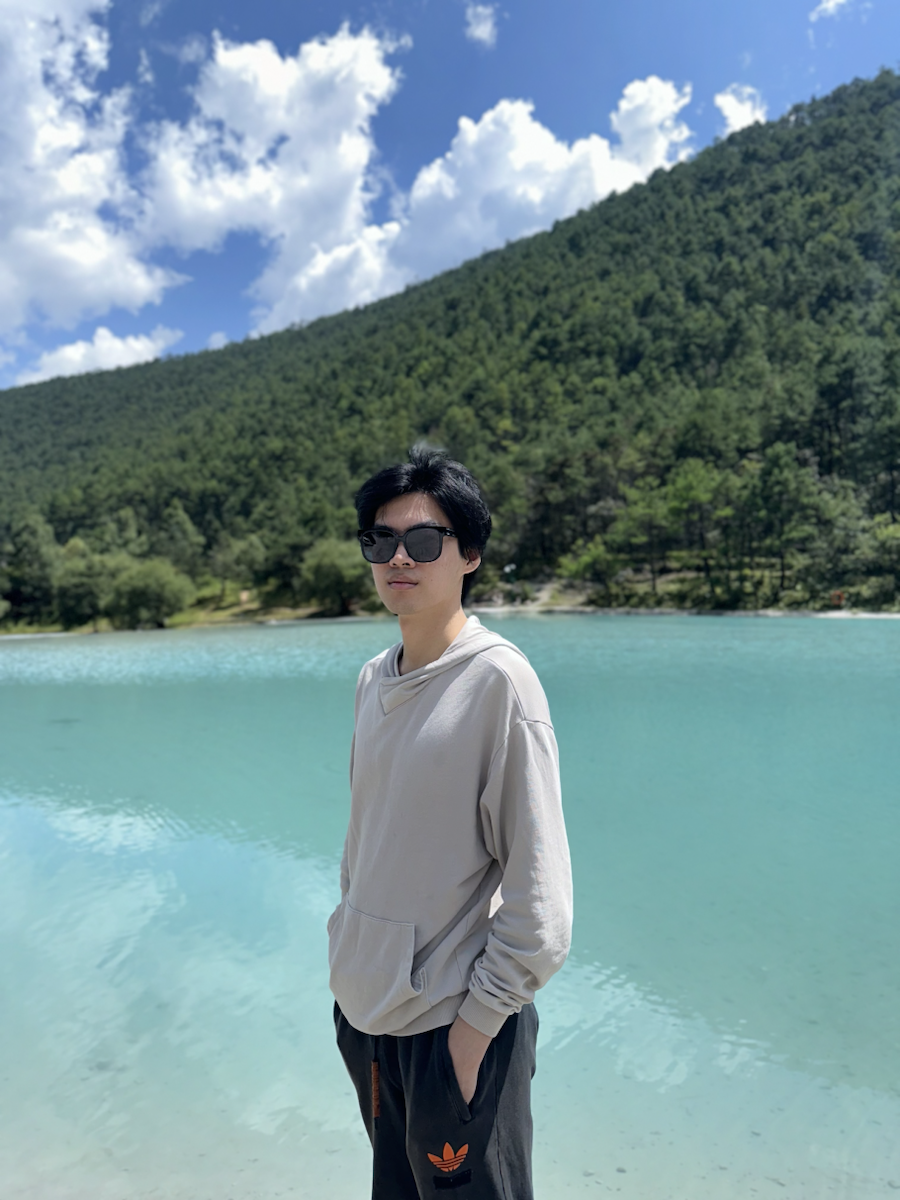
I am a PhD candidate in Computer Science at the University of Bristol, researching image processing, computer vision, and object detection in challenging real-world environments. My current work focuses on atmospheric turbulence mitigation for long-range imaging and video, with an emphasis on building systems that remain useful beyond the lab. My PhD is funded by the China Scholarship Council-University of Bristol PhD Scholarship, and my supervisors are Professor Pui Anantrasirichai and Professor Alin Achim.
Image processing, computer vision and object detection, with an additional interest in Cyber & Physical Security.
I completed my work on eDNA Detectives as part of the OceanX–University of Bristol collaboration. The wider collaboration was featured in University news following the showcase of ocean-science projects at the OceanX Summit 2026 in Singapore. Read the Bristol news article.
I am supporting Computer Science A (CSA) as a Teaching Assistant at the University of Bristol. Unit details (COMS20008, 2026/27).
I joined the OceanX–University of Bristol collaboration to develop the browser-based science game eDNA Detectives.
Our preprint, MMDLNet: A Multimodal Deep Learning Network for Post-Collision Injury Prediction and Triage Support, is now publicly available on SSRN.
Our abstract, MMDLNet: A Multimodal Deep Learning Network for Post-Collision Injury Prediction, was accepted for presentation at IRCOBI 2026 (International Research Council on Biomechanics of Injury). Now available as a Short Communication: PDF · Conference proceedings.
I joined the Visual Information Laboratory to work on atmospheric turbulence mitigation, long-range imaging, and computer vision systems for challenging real-world environments.
Imperial College London's Department of Computing named me as one of three winners in the technical complexity category of its Computer Graphics coursework awards. Read the Imperial news article.
DeTurb explores atmospheric turbulence mitigation with deformable 3D convolutions and 3D Swin Transformers for clearer long-range video restoration.
Researching video enhancement and inverse problems for challenging environments, with a focus on perceptual significance, atmospheric turbulence, and real-world deployment.
Built a broader systems perspective through cyber-physical security, infrastructure protection, behavioural science, web security, and computer graphics.
Developed a strong base in computer vision, distributed systems, software engineering, graphics, security, and applied machine learning through both coursework and collaborative projects.
Supervisors: Professor Pui Anantrasirichai and Professor Alin Achim.
Supervisors: Dr. Claire Baker and Professor Arnab Majumdar.
Tracking and documenting a Collagenous Gastritis case, with attention to clinical progression, evidence organisation, and longitudinal record-keeping. A detailed preprint is currently being prepared.
I contributed to the development of eDNA Detectives, a browser-based science mystery game, as part of a collaboration between OceanX and the University of Bristol. The project adapted immersive ocean-science museum content into an interactive educational experience for classrooms, museums, and science festivals. The wider collaboration was featured in University of Bristol news following the OceanX Summit 2026.
One of three named winners in the Department of Computing's 2025 Computer Graphics coursework awards, recognising technical complexity in ray-tracing implementations.
My GLSL ray tracer featured physically based rendering, soft shadows, one-bounce global illumination, and BRDF-based material interactions. Score: 99.5 / 100.
Won with the game “Toxic Tide” after two days of coding, collaboration, and rapid creative development around the themes of contamination and horror.
Recognised for extracurricular involvement and continued development in teamwork, communication, leadership, and problem-solving beyond degree requirements.
A lightweight recurrent approach to restoring turbulence-degraded video in dynamic scenes. It processes two frames at a time, combining multi-scale restoration, temporal warping, and motion-adaptive fusion to preserve detail and reduce flicker with efficient inference.
Conference short communication combining crash descriptors, event data recorder time series, and post-crash images to predict injury severity and support early post-collision triage. The related full manuscript is listed separately below as an SSRN preprint.
Full manuscript on multimodal deep learning for post-collision injury prediction and triage support, available as a preprint on SSRN. This is the related full-length work accompanying the IRCOBI 2026 short communication listed above.
A framework for atmospheric turbulence mitigation in long-range imaging that combines geometric restoration with multi-scale transformer-based enhancement for sharper, clearer reconstructions.